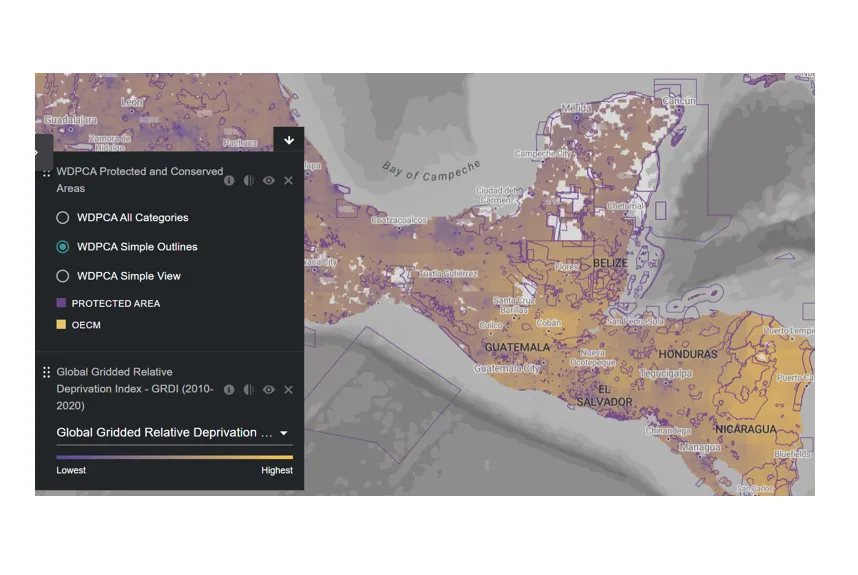
CIESIN’s Global Gridded Relative Deprivation Index (GRDI), Version 1.10, has been added to the UN Biodiversity Lab (UNBL) Viewer, expanding the platform’s suite of global datasets. The GRDIv1.10 dataset measures relative levels of multidimensional deprivation and poverty at a spatial resolution of 30 arc-seconds (~1 kilometer at the equator), with values ranging from 0 (lowest deprivation) to 100 (highest). It is derived from an analytic hierarchy process combining sociodemographic and satellite-based global spatial inputs: the Subnational Human Development Index (SHDI), Infant Mortality Rate (IMR), gridded Child Dependency Ratios (CDR), nighttime lights intensity, and the proportion of built-up area within each grid cell.
With this addition, GRDIv1.10 joins more than 400 curated data layers available through UNBL, covering nature, climate change, and sustainable development. The platform enables policymakers, researchers, and other stakeholders to leverage spatial data for informed decision-making and targeted action. The UNBL Viewer is a free, open-source tool that requires no prior geographic information systems (GIS) experience. Powered by UNEP-WCMC and Microsoft’s Planetary Computer, it integrates advanced technologies with user-centered design to support accessible, state-of-the-art geospatial analysis.
Portions of this news blurb were edited with the assistance of AI tools to improve clarity and readability. All content was reviewed and validated by the authors.