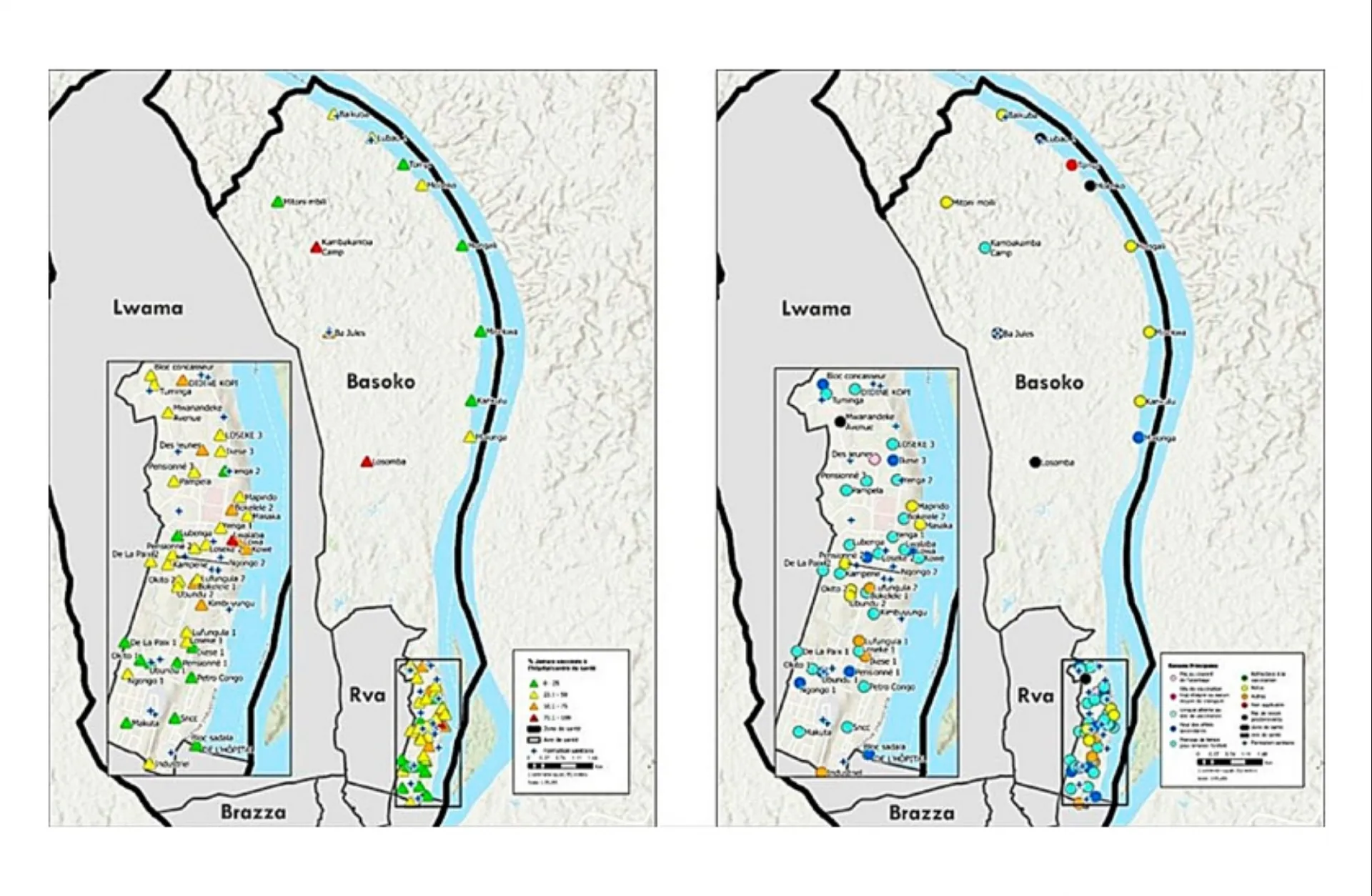
A new study co-authored by Kevin Tschirhart, published in Vaccines, details a successful proof-of-concept project in the Democratic Republic of the Congo demonstrating how geo-referenced microplanning can identify and reach children missed by routine immunization services.
Conducted in the Kindu and Kibombo Health Zones of Maniema Province, the project combined house-to-house enumeration with participatory mapping to locate children who had never been vaccinated (NVC) or had an incomplete vaccination schedule (IVC). The study found that 38% of children in Kindu and 50% in Kibombo were NVC, with non-vaccination often linked to knowledge- or belief-related barriers, or access constraints in remote and riverine areas. By applying these geospatial insights to three rounds of Periodic Intensification of Routine Immunization (PIRI), health teams successfully vaccinated at least 40,000 children-- approximately 30% of the 0-59-months-old population-- prioritizing NVC and IVC populations.
This work demonstrates how integrating innovative geospatial methods with community engagement can strengthen immunization systems, close persistent coverage gaps, and reduce the risk of vaccine-preventable disease outbreaks. It also underscores the value of operationalizing high-resolution spatial data to drive measurable public health impact in complex settings like the DRC.
To learn more about CIESIN’s work in the DRC, see here.
---
Portions of this news blurb were edited with the assistance of AI tools to improve clarity and readability. All content was reviewed and validated by the authors.