CIESIN Contributes Spatial Socioeconomic Expertise to Global Study of Emerging Infectious Disease Risk
CIESIN’s Juan F. Martinez is a contributing author of a new study, The anthropogenic fingerprint on emerging infectious diseases (Gibb, R., Ryan, S.J., Pigott, D.M. et al., 2026), published in Nature that examines how human-driven environmental and socioeconomic factors shape the global geography of emerging infectious diseases. The paper brings together 58,319 outbreak records in 169 countries across 32 diseases and 16 social and environmental drivers, making it the largest data-driven assessment to date of the environmental drivers of emerging infectious disease outbreaks. Martinez contributed data and expertise in spatial socioeconomic information to the international research effort.
A key CIESIN contribution to the research was the Gridded Relative Deprivation Index version 1 (GRDIv1), which the study used to represent socioeconomic vulnerability as one of the potential drivers of disease outbreaks. Developed and published by CIESIN with support from NASA’s Socioeconomic Data and Applications Center (SEDAC), GRDIv1 integrates multiple socioeconomic dimensions to characterize relative deprivation and social vulnerability spatially. This allowed the researchers to examine socioeconomic vulnerability alongside other social and environmental factors such as forest cover, ecosystem fragmentation, livestock density, and changes in temperature and precipitation. The study’s results show that the relationship between social vulnerability and outbreak geography varies by disease group, underscoring the importance of incorporating spatial socioeconomic data into disease-specific analyses.
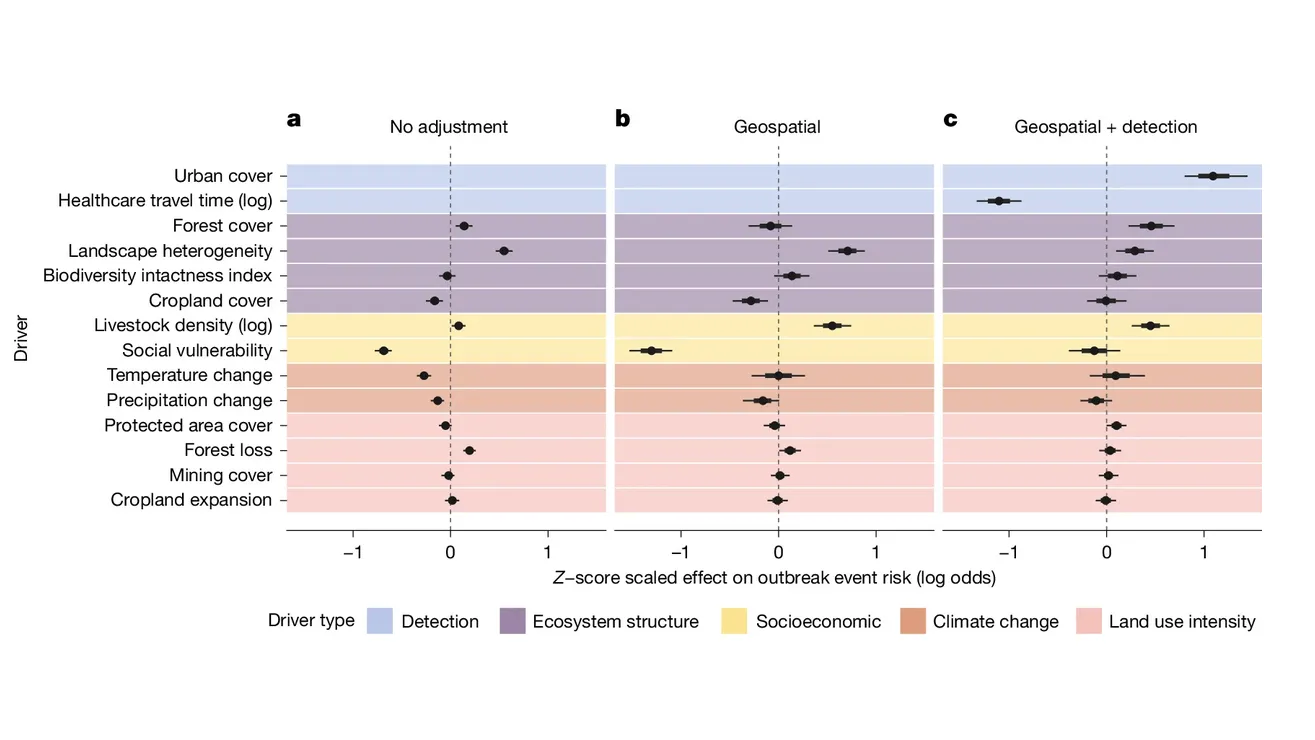
In the image above, the results are summarized across individual disease models, for all diseases (a; n = 31) and for subsets of zoonotic diseases whose main mode of transmission to humans is either vector-borne (b; n = 17) or direct (c; n = 10). For each driver, estimates of the mean marginal effect size are shown (posterior median, 67% and 95% credible interval) across all diseases for which that driver was tested. In this context, social vulnerability appears to be a negative driver for all diseases, and vector-borne diseases in particular.
The researchers found a clear “anthropogenic fingerprint” on emerging infectious diseases, but no single set of environmental factors explained outbreaks across all diseases. Risks were generally highest in mosaic landscapes where people and livestock live alongside forests and fragmented ecosystems. These factors, together with long-term declines in precipitation, showed particularly strong associations with several vector-borne diseases, including dengue and Lyme disease. Directly transmitted zoonotic diseases, such as Ebola and mpox, shared fewer common drivers.
The study also highlights the importance of healthcare access in shaping where outbreaks are detected and reported. Across diseases, outbreak reporting declined by a median of 32% for each additional hour of travel time from a healthcare facility, indicating that observed outbreak patterns are influenced by inequalities in healthcare access and disease surveillance. The authors conclude that emerging infectious disease risk is multi-causal and that prevention strategies need to combine disease- and region-specific evidence with stronger health systems, coordinated disease surveillance, and appropriate ecosystem-based interventions.
Martinez’s contribution and the use of CIESIN’s GRDIv1 demonstrate how spatial socioeconomic data can strengthen interdisciplinary research on the relationships among human populations, environmental change, social vulnerability, and infectious disease risk. The study was led by researchers at University College London, the University of Florida, and Yale University and was published in Nature on September 23, 2026.
Read the full article: https://doi.org/10.1038/s41586-026-11058-6
Portions of this news blurb were edited with the assistance of AI tools to improve clarity and readability. All content was reviewed and validated by the authors.